


Tag: theory
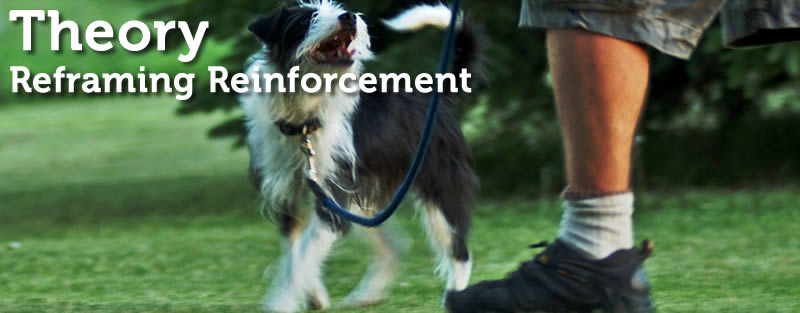
Reframing Reinforcement: Overpaid and Under-Reinforced
28th July
I learned this lesson not too long ago with Hops. Focusing on Paying and Rewarding this little Jack Russell Terrorist for good work meant that I never get to reinforce anything. It just wasn’t working…
Dog Ethogram
10th December
Apryl and I have had the pleasure to work with Sue Sternberg both as a student and an instructor. She’s an amazing lady and her tireless and well documented work with rescue dogs is something to be admired.
Here’s a great site for some much needed information on canine behaviors.
Sue Sternberg’s Dog Ethogram.
Glossary of Terms for the Experimental Analysis of Behavior
7th December
This is one of my favorite online resources for technical Behavior terms: Glossary of Terms for the Experimental Analysis of Behavior.
It is hosted by the University of Iowa and was written by: Brittan Barker, Joy Kreider, Jessie Peissig, Greta Sokoloff, Maura Stansfield.
I’ve used this glossary for about 5 years now when I need a definition. It’s easy to navigate and simple to understand using language that seems just a little bit less mumbo-jumbo-ish than many of the other resources that I’ve ran across on the net.
Feel free to add your favorite resource in comments below.
Marking with a Finger Point
2nd December
Download Movie! Right Click>> Save As…
When working with Multiple Dogs, how we mark is important. One of the things we like to do at Pawsitive Vybe is to use a Finger Point to mark behaviors.
The above video is a demonstration of the Finger Point Mark. It’s real nice for keeping the dog’s focus on the handler and for silently marking behaviors.
Conditioning the Finger Point Mark
This is no different from conditioning the Positive Marker or the Clicker. If we want to be boring we can point then feed the dog, establishing a consequent relationship – the Point happens then comes the cookie.
We can also mark Attention (unsolicited eye contact) and reinforce with a cookie. This is the preferred method of Pawsitive Vybe of charging the marker.
Of course we can just start freeshape it by simply using it … Read More »
Some Thoughts on Teaching in Drive
2nd December
A dog that is engaged in drive is often hard to handle and gives many good discdoggers fits. It is important for handlers to be able…
Humor, Repetition and the Classical Condition
28th October
[info_box_2 title="Author's Note"]
Yesterday, I did a piece on Reframing the Dog’s Understanding of the Door. A couple of the comments pointed out some gaps in the one ‘how to’ paragraph. That paragraph was not meant as a lesson plan, it was just a quick hit explanation of the technique. Today’s installment is also not meant as a lesson plan. This piece is about some concepts we can use to desensitize our dog to the classical condition.
[/info_box_2]
Pavlovian Humor – Make Their Drive a Joke
Humor is essentially taking people down a common path and popping them out into an unexpected destination:
“Three guys walk into a bar,”
The listener knows what’s coming: a long drawn out story about a minister, a priest and a rabbi, or something like that. Eyes roll,”Oh no, not another one… this is going to … Read More »
Pressure
5th July
As dog trainers we need to be sensitive to the concept of pressure.
Positional Pressure
If we lean over our dog, bending at the waist, we’re putting pressure on the dog. If we lean back with our feet closer to our dog than our upper body we are relieving pressure.
Facing a dog frontally, head on, adds pressure and turning to the side, giving them an oblique look at the handler is relieving pressure.
Stepping towards a dog adds pressure while stepping back relieves pressure.
When we add pressure we are likely to get a freeze or movement away by our dog. When we relieve it we will get an approach.
Pressure is not necessarily bad. It’s just a fact. Understanding how to apply and release pressure will allow a handler to push and pull their dog around the field, enhancing speed and … Read More »
Variable Reinforcement
5th July
When we start with marker training, the reinforcement schedule, or reward schedule is a fixed ratio of 1:1 – 1 Behavior : 1 Reward.
This is a candy machine. Think about a candy machine for a moment.
What happens after the candy comes out? Do we hang out or do we leave?
What if no candy comes out or the machine gives the wrong candy? Do we put more money in? Heck no! That candy machine stole our money. If nobody’s around it might catch a beat down.
Candy machines that don’t pay out or give us the wrong kind of candy violate the rules of a 1:1 reinforcement schedule. It’s not playing fair, so we get frustrated and avoid losing more money.
As our dog gets better at learning or when the skill we’re working gets stronger we need to … Read More »
Criteria
5th July
Those of you who are dog trainers have been waiting for this, I’m sure.
Criteria is an extremely important component of dog training, possibly the most important. As we really start to get our dogs conditioned to taking note of their behavior and replicating it to positively effect their consequence, they become extremely bright and are able to learn extremely fast. They will learn behaviors very quickly.
Setting clear and appropriate criteria allows the handler to teach the skills we want our dogs to learn quickly and efficiently.
Many times it is the handler’s failure to set and enforce criteria at the beginning or at a critical stage in learning that causes those stumbling blocks in our training. Muddy criteria with a smart dog is a recipe for disaster. It can lead to confusion, poor performance and an avoidance of work.
If … Read More »
Rate of Reinforcement
5th July
The nice thing about bringing the game of disc in tight to the handler is that we can dramatically increase the rate of reinforcement in our game.
Rate of reinforcement is a number of rewards per amount of time.
Traditional positive training says that we should shoot for 15-30 rewards per minute for learning and tough challenges. That’s a cookie every 2-4 seconds. A high rate of reinforcement of success creates a snowball effect. It becomes easier and easier to succeed. Successful performance of a behavior becomes habit.
There’s no way to get a high rate of reinforcement in the game of disc by throwing 30 yard throws. Due to the physical limitations of delivering reinforcement over long distances, a high rate of reinforcement can only take place close to the handler.
Once the dog is conditioned to taking reinforcement close to the … Read More »
Last updated by at .


Recent Comments