

Eight Ways to Slow Down Your Disc Dog
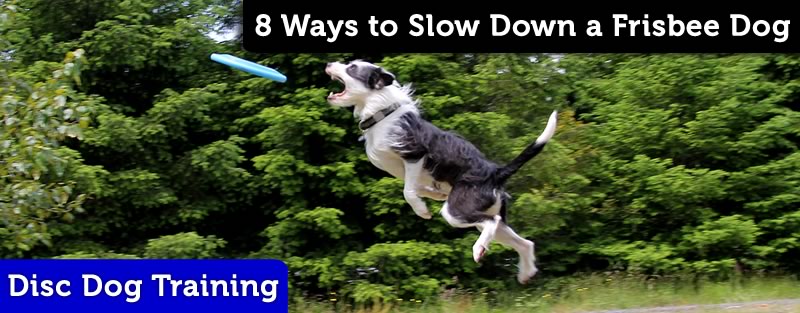
Dogs that run too fast cannot leap well. Odds are if you have a disc dog that doesn’t leap, he is probably running too hard to catch the disc. If you’re running too fast, you cannot adjust your stride and collect for proper leaping. Even Michael Jordan can’t leap if he’s sprinting as fast as he can.
Slowing down a disc dog’s on field movements is important for safety and performance. It is also important for a dog’s frame of mind as well.
Thoughtful and purposeful work is always better than bonkers.
Here are 8 tips to help you slow down your dog:
Don’t Throw
The simplest way to slow down a dog and to get him to think about what he is doing is to send him around and just not throw. Many dogs will run a full 40 yards before looking back at the handler. If you withhold the throw a few times (perhaps many – Mo took 30 reps) the dog will go around and stop and look at you. When he does, throw a nice easy catch to the dog; something kind of boring that doesn’t allow him to move too fast or something that drives him back closer towards the handler
This same technique can be used after a cued Drop, or after a familiar set up move that leads into the sequence. Just stop and wait a moment. The dog has to pay attention to you.
Attention
Speaking of Attention… Attention is unsolicited eye contact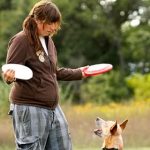 Unsolicited eye contact or Attention is a great way to hook up with a dog. If you have something the dog wants he should give eye contact in order to get access to... More in the presence of something the dog wants. It’s an amazing skill for disc dogs to have.
If the handler has the disc and the dog wants it he will give eye contact. Do a set up move Set Up Moves are tricks that are used to establish timing and position in disc dog freestyle. Traditional tricks include: Around, Through, Backwards Through, and Scoot, but any or all of your tricks,... More and wait for eye contact. When he gives it, reinforce him with more play or a disc.
This simple skill changes the nature of play for dog and handler.
Oppositional Feeding
Leverage reward placement to your advantage by using Oppositional Feeding and the concept of throwing in the opposite direction the dog is moving. He will slow down and this irregular and unpredictable situation combines with with reward placement to make him actually think out there. He will slow down.
Be careful to vary timing and placement and, at times, don’t throw. It’s easy to exchange a sprint back and forth for discs with a groovy circular sprint for discs. Remember that your goal is to slow him down. Avoid predictability.
Bent Cavaletti
The Bent Cavaletti drill that we created here at Pawsitive Vybe was designed to slow dogs down and to help handler’s learn to compute the placement of targets. It’s a stellar exercise for dialing in purposeful and thoughtful approaches to leaping catches. Any time the dog is set on the Flank
Around the World
An Around the World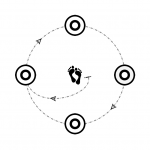 An Around the World is a disc dog flatwork pattern consisting of 4 catches in a circular pattern around the handler. This pattern is typically larger than 5 yards and often features creative... More (discs thrown @ 12 o’clock, 3 o’clock, 6 o’clock, and 9 o’clock) thrown with the intent to slow a dog down can be used to limit speed and to help him collect well and make good plans to intercept the disc.
Shape & Capture
Creative and observant handlers, dog trainers in particular, can shape a dog into moving slow. Simply capture the moments of slower or more thoughtful movements, mark those movements, and most importantly, reward them with the same tone — slowly and methodically. A high energy “YES!” and flash of movement for the toss might not be a good idea for reinforcing slower movement.
Set up situations and shape the slower movement (we call it Pace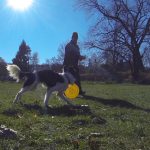 When working the flank, a dog often goes from running very hard to a more easy going pace. She adjusts her pace to match you or to read the situation. We call this... More here at Pawsitive Vybe). We use the PVR and Around the World quite a bit for shaping and capturing slower movement, but any situation that helps shape the dog into moving slower can be used.
Throw Well Into the Wind
Throwing into the wind makes it more likely that the disc will float. Floating discs move slower and if the placed appropriately the dog can’t run too fast or too far.
Slow Down
The handler has so much control over the tone and pace of the game of disc dog freestyle. You literally are in charge out there and you can reinforce whatever it is you are looking for. How you go about reinforcing the dog’s behavior largely feeds into the kind of game you develop. If you go out and totally cut loose, chucking crazy tosses all over, or you create and lose moves and sequences on a daily basis, or are overwhelmed by the dog or performance pressure, odds are you have a fast dog that is hard to control.
Keep your head about you. It’s not nearly as fast as you think it is. Take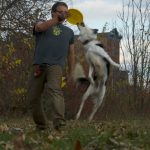 A Take is a cued Bite that replicates the placement and timing of a throw. Usually used with overs, vaults, and flips, the Take is a powerful teaching tool for creating habitual leaping... More your time.
Breathe.