



Disc Quan Do Throwing | 12 Hands Form

Each belt of Disc Quan Do features a 4-throw disc dog throwing form. Let’s call it an X Hands Form. The first belt level, White Belt, has the 4 Hands Form. The White Belt 4 Hands Form requires specific throws: Backhand The Backhand toss is the traditional disc throw. While it might not be the easiest throw of them all, it is the easiest to throw a hundred yards, and it is the easiest... More, Sidearm, Push, and the Overhand Wrist Flip. All belt levels after that, you get to choose your throws. The 2nd belt level, Yellow Belt has the 8 Hands Form, 4 throws of your choosing – 2 that spin
 Spins and Twists are tricks where the dog spins 360 degrees in a clockwise or counter clockwise fashion. Spin is clockwise and Twist is counter clockwise so it is important to have a... More clockwise and 2 that spin counter. Each belt level adds 4 more throws – 2 clock and 2 counter.
So a 12 Hands Form is the throwing form for the 3rd belt level which is the Green Belt. I have decided that my Green Belt ‘X’ Hands Form will be this sequence of upside down throws.
Why Upside Down?
In this week’s DiscDogger Weekly show, DiscDogger Weekly #14, featured collection and tracking work under the tongue-in-cheek “Premature Ejumpulation” moniker. Premature Ejumpulation, aka Irrational Leaping is a common problem that stems from over-pursuit.
Over-pursuit happens because our dogs get wise to the flight characteristics of well placed throws and where we habitually place them. Well placed throws that are consistently placed don’t really need to be watched and tracked, they can be calculated. The standard situation and consistency of reward placement allows the dog to algorithmically know where it is going to be.
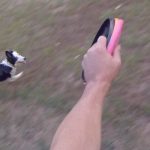
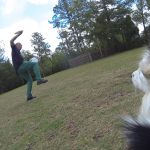
Upside down throws change that calculus. They fly funkily and erratically. The normal calculation doesn’t work, and the disc “just doesn’t fly right”. This uncharacteristic flight path forces the dog to actually watch and track the disc rather than take a quick look and making a calculation to meet the disc where it should be.
Why Work the X Hands Form?
While working the dogs with upside down throws I was having trouble handling and loading the discs and delivering the throws in a timely fashion. It was too hard to try to think through simple disc management, watch the dog, and deliver the disc to the right spot Spot is a “go to a place”, or “go to a mat” behavior. This means that the dog seeks out and performs a duration behavior on a spot of the handler’s choosing. A... More.
The X Hands Forms are great for precision and accuracy training, but that’s just one benefit of working them. The real benefit of this disc dog throwing form is in learning how to reflexively and efficiently load the discs into the throwing hand and how to shift your feet and align your body to deliver the throws to the target. Creating muscle memory of loading the discs and setting your body in motion and in line for the throw frees up your mind to do other things like read the dog and gives you extra time get prepared.
I needed some more time and more freedom for my mind to process and deliver upside down discs to a moving dog. Working the X Hands Form was a no-brainer. 10 minutes of work and I’m able to load discs and understand what I’m doing with upside down tosses, and am now able to do this on the fly, successfully, with my dogs.
Why the 12 Hands Form?
Throwing discs with creative releases is part of disc dog freestyle. Throwing upside down tosses are both creative and useful releases. Running several dogs, I currently don’t have a ‘standard’ 12 Hands Form. It seems like a good idea to use the Green Belt 12 Hands Form to exercise my upside down throws.




Responses