


Flipping the Field for Toss and Fetch Retrieve Speed

This is the third and last installment of our Improving Toss and Fetch Retrieve Series. This content will be covered completely in video, images and text in our next Disc Dog Foundation online distance learning class which starts Wednesday, Oct. 12, 2011. It will also be added to the first update of the DiscDogger’s Toolkit.
Reward Placement and Field Pressure in Toss and Fetch
In the rules of Toss and Fetch, the field only goes away from the handler in one direction. It’s a law of Toss and Fetch, actually. The throwing line defines the direction of play. Anyone who plays Toss and Fetch can easily see that the cool part for the dog takes place while sprinting away from the handler. There is nothing to look forward to on the way back to the handler after the challenge and glory of catching the disc. Frequently this becomes a dog’s basic understanding of long throws. This let down factor when the handler appears on the horizon is a large part of the problem with dogs who have a slow retrieve in Toss and Fetch.
The structure of the field itself also works against teams when playing a traditional game of Toss and Fetch. The throwing line is the edge of the field exerts Pressure upon the dog. That Pressure Pressure comes in many forms in dog training. Positional Pressure, Performance Pressure, Environmental Pressure, the Plane of the handler’s body. Pressure is a fact. How you wield it or leverage it is up... More slows a dog down if it is not overpowered by the value on the handler.
There is a simple way to change this understanding and to relieve that pressure. Just flip the field on every other throw. This will take the Reward Placement – way out there!!! – of the game of Toss and Fetch and leverage it to create more speed.
Flipping the Field
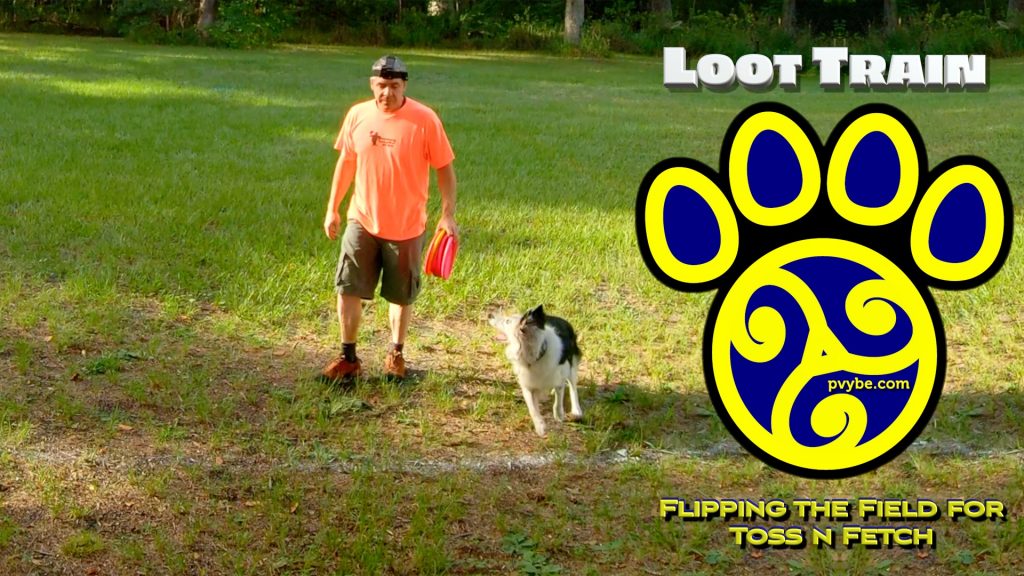
Flipping the field means playing in both directions. Instead of starting at one end of the field and throwing only in one direction, place yourself in the center of the field and throw in both directions. This should be done with two or more discs.
Drop and Fly
Two discs can be used, like bitework for retrieve as covered in the last installment of this series. The handler takes two discs and throws one long. The Drop is cued as the dog is returning, it is marked,”Yes!” and is reinforced with a long throw in the opposite direction of the first.
This throw can be made immediately after the cued drop happens, slightly after or may be timed to the dog’s movement
If the throw happens immediately after the drop it will be very challenging for the dog to make the catch. It will force him to run hard after the target. It will reinforce the Drop on the run quite well. Tremendously challenging disc placement probably does the most for improving retrieve speed, but be careful. If the target is always uncatchable the dog may start to slow down because there is no opportunity in that impossible catch. This could really damage a dog’s drive for long catches. It also could create a pattern of missing discs that could teach him that the catch is not an important part of the game.
Waiting a bit before throwing can give a dog a better chance of making the catch but it may or may not reinforce the Drop well. It is great for most dogs that are not total disc monsters. A momentary pause before throwing allows the handler to deliver discs that are successfully caught. It will totally help the dog’s retrieve speed.
Timing the throw to a dogs movement will yield the least speed increase and should really only be used on lower drive dogs and dogs that need a lot of help going after long throws for a limited time. This is essentially waiting on the dog and will not have as much effect on building speed. It also could promote a dependence on the presentation of the next disc for speed.
Double Disc Retrieve
If you wait for the dog to get to you and then ask for the Drop you can work on a full blown retrieve. This can build a retrieve so blazingly fast, it’s ridiculous. Think about it. Your dog comes running back with the disc, you call the drop shortly before he arrives, say 3 yards away. Dog drops, and you immediately throw a monster toss behind you in the other direction. It doesn’t take much imagination to see the end result. The dog will come hauling back, drop when asked and continue running for the catch. It’s not hard to turn that into a fluid drop and go around after you’ve got the haulin’ butt back to the handler part down.
Single Disc Retrieve
Once the Double Disc Retrieve is nailed down, or at a time of the handler’s choosing, wait for the retrieve, call the Drop when the dog arrives and bend down and pick it up for a throw it in the opposite direction. This, very closely, represents a game of Toss and Fetch and generalizes the previous drills into a normal game of toss and fetch.
Rewarding with Action and the Consequent Cue
It is extremely important that the performance of the cued Drop, happens before the next disc is presented for throwing. The Drop needs to make the next throw happen and the dog needs to believe that. Once he believes that the cued Drop makes things happen he will carry the disc until he hears the Drop cue, no questions asked.
Also, once you start the Double or Single Disc Retrieve with the Drop and fluid Go AroundAn Around, or a Go Around is the traditional disc dog set up move. The dog goes around the handler’s body in a clockwise or counter clockwise fashion allowing dog and handler to... More instead of the throw behind you, the Drop will lead to the opportunity to run out and make another catch.
Randomize
All of these drills can and should be randomized. The location of the cued Drop needs to be randomized. Don’t get stuck in any one mode for too long or unitended patterns may be created. Your dog can learn patterns that you probably don’t want to have to un-teach.
Don’t forget to work with a single disc at times and to work some regular old Toss and Fetch, and if you’re one of those real anal types, go ahead and paint the field and get your timer out every once in a while. Just make sure you get value on the handler and get some reward placement on the flip side of the field and you’ll be OK.
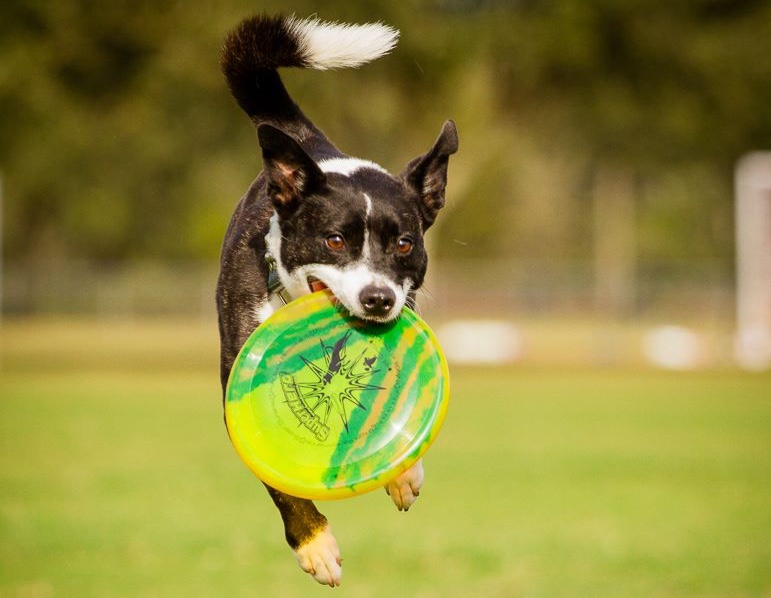
I have the opposite problem. He comes tearing back but drops the disc out away from me. This is especially the case if I have another disc in my hand. He wants it bad. We have worked a lot of single disc and he does better with that but as soon as I switch to 2 discs he drops far away again. I want him to drop all discs in close so for freestyle they don’t get spread all over the field.
What you really want is the Drop on Cue, John.
Predict the Drop and call it. Never, ever miss the Drop Cue. Initially you will be playing to his game, predicting when he will drop and then cuing,”Drop!” at that moment when you believe he is dropping. If he drops before you call it, stop for a moment… 3-10 seconds… reset and start again.
You want to create a clear understanding that the cued Drop leads to more play. To do this you will capitalize on the dog’s offered behavior (early drop), take ownership over it by always cuing it, then slowly but surely ask for a little more (closer to you).
The consequence of stoppage of play for dropping on his own contrasted with Dropping on Cue=Game! should be impossible to mistake for the dog.
Then it’s just a matter of upping the ante.
Again the key is the successful performance of a drop on cue – over and over, and over again. Create a pattern – Drop! >> disc comes out >> More Play!. Then, when they have that understanding, you challenge them and ask for more.
Hope that makes sense.
Thanks Ron. I’m trying to do more advanced stuff like double throws before I have mastered the foundational stuff. Time to go back to basics.
Great advice!
It just takes some dedication and belief in the technique and then some steady management of situations to ensure that the concept of Drop on Cue is what makes stuff happen.
That means calling the out all over the place, all the time. Many times, predicted. If you’re throwing a double throw, call the Drop. Once it’s installed you don’t need to be so anal, but until it’s installed you’ll need to be on top of it.
Peace~
BTW, I love the disc dog tool kit. It’s great.
Awesome! http://discdoggerstoolkit.com 🙂
Toss and fetch gold. Kind of easy to forget to work the basics, teach the fundamentals, but if you want great toss and fetch results, gotta put in the time with great strategies like these. After a year of working on freestyle, I’m going to put more time into the TF game.
I need to do some work on Toss and Fetch too Jay, but not on the Retrieve. Our dogs have so much value on the handler that they are turning in the air during vaults so they can get back to us quicker – not a good thing from a safety standpoint. All of our dogs except for Prima have SMOKIN’ retrieves.
I think the key thing here is isolation of behavior and stepping outside the rules of the game so you can teach the key elements of the game. People are reluctant to do that.
Peace~
This technique, and especially calling the drop, has helped Ember’s whole frisbee game a ton. She used to drop the frisbee after she caught it and did not like to bring it back. She just wanted a new disc. By making the drop a reason for her to get to chase again it really seemed to hit home for her. Although I did feel silly calling a drop way out in the field, it slowly came together. She occasionally still gets a bit zealous in her desire to get to the next disc but going back a little bit always helps and we are at the point that we can play a freestyle game without me having to run around after discs. This technique helped my golden retriever, Logan as well. He used to only play with one disc but my husband didn’t care so we never worked on it. It kind of bothered me so I started using the drop to cue another throw with another disc. It would happen so fast its like he never got to think about which disc was “his”. Now he goes after whichever disc is being thrown at the moment. Thanks for the reminders!
-Lindsay
That’s awsome, Lindsay. I remember you being a bit skeptical at the start too. Pretty cool once it starts working for you, huh?
It’s really funny when you see that the dog totally understands that you can’t drop it if you are not carrying it. lol
Peace~
Ron, great post. Chance (18mos) and I are having a similar problem to John’s. He hauls butt to get back to me but if I have another disc in my hand, he drops right after the catch. If I don’t have a disc, he brings it back but does a drive by and wants me to chase him. I don’t engage but I usually have go go pick up another disc to get him to drop. Is this just a matter of being patient and consistently calling the drop even if he’s 10-20 yds away?
Ha! It sounds like we have the same dog.