

Time and Space

Time – Throw Early!
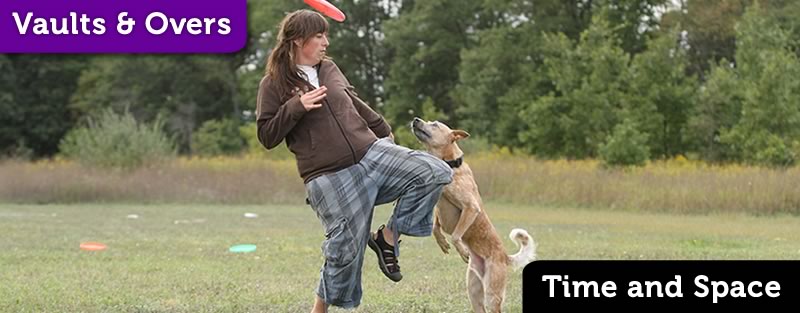
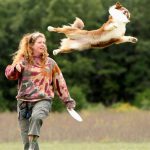
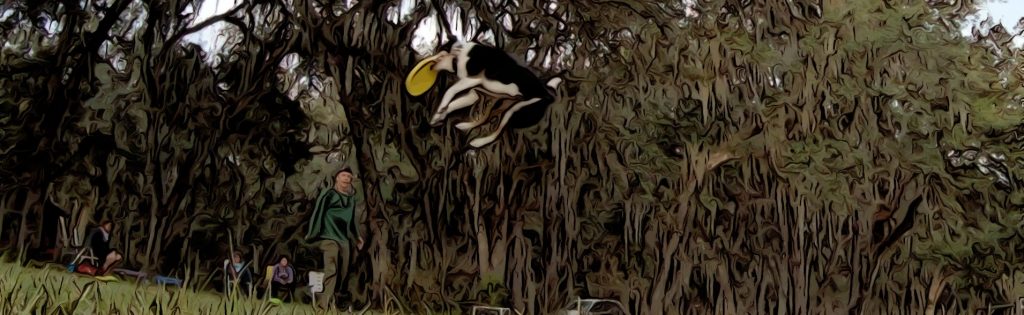
When throwing for vaults and overs the disc needs to be in the air very early — so early, it’s ridiculous. The dog needs to know where the target is going to be before they leave the ground. This is critical in terms of safety and in terms of performance.
If the dog leaves the ground for a target they make one decision, the right decision – “There is my target and this is how I’m getting there.” It’s a perfect plan… a mid-air interception.
Too Late
But if the dog leaves the ground and the target is not where he expects it to be he’s thinking,”Where is my Target and how am I going to get there?”
Leaping without knowing where the target is, leaping to an empty spot Spot is a “go to a place”, or “go to a mat” behavior. This means that the dog seeks out and performs a duration behavior on a spot of the handler’s choosing. A... More in space or to the vaulting platform, is guessing. Guessing is not at all like leaping for the target. Throwing late leads to multiple decisions on the fly. Frequently the dog guesses wrong, the disc is misplaced or wind blown which leads to a dog flinging themselves to try to catch the target.
Another way to think about throwing vault and over tosses late is that it becomes the handler’s responsibility to put the disc in the dog’s mouth. Not at all an easy proposition from a handler’s perspective unless takes are used or tiny tosses are used.
It is possible to make many vault and over tosses late and be successful. Many players, and many very good players, do. That said, the most frequent mistake on vaults and overs is throwing too late. It is the most common way to miss a vault, to vault poorly and/or crash.
Space – a Stride and a Half
Generally speaking a dog need at least a stride and a half of distance to perform a vault or over. That distance will change based upon the speed and size of the dog. One of the most common mistakes with practicing vaults is not setting the distance away from the handler appropriately.
A big vault or a big over with a dog that’s moving starts at about 20 feet away, minimum. A properly timed vault or over that starts with the dog standing still is usually about 7-10 feet, but again that is dependent on the dog’s stride length.
Crowding the Dog
If the dog doesn’t have enough space, the handler is crowding him and some dogs don’t have the athletic ability to perform when being crowded. Not all dogs have the vertical leap or explosiveness to make it up to or over the obstacle are not aggressive enough to just pop into action. From a handler’s perspective crowding the dog also means that things happen faster, our throws are going to be shorter, and there is less prep time to get synced up with the dog.
If the dog is crowded the vault or over becomes less of a planned skill and more of a reactive one. The dog can’t plan, there’s no time. So he reacts. This leads to anticipation, missing the obstacle, flailing and host of other performance issues. Of course spontaneous reaction can be a powerful training tool… just sayin…
Too Much Space
If a dog is given too much space, there are a different set of problems. Too much speed, too big a leap, too much scale; mistakes at speed can be dangerous and easy to make. A team must have great foundational performance of our vaulting and over skills with perfect disc placement and timing if vaults and overs are going to be worked on the run.
Giving a dog too much space can lead to a lack of controlled performance. Running into the obstacle, missing the catch by a mile, barely using the obstacle, crashing and rolling all are more likely to happen when a dog has too much space to set up.
Timing.
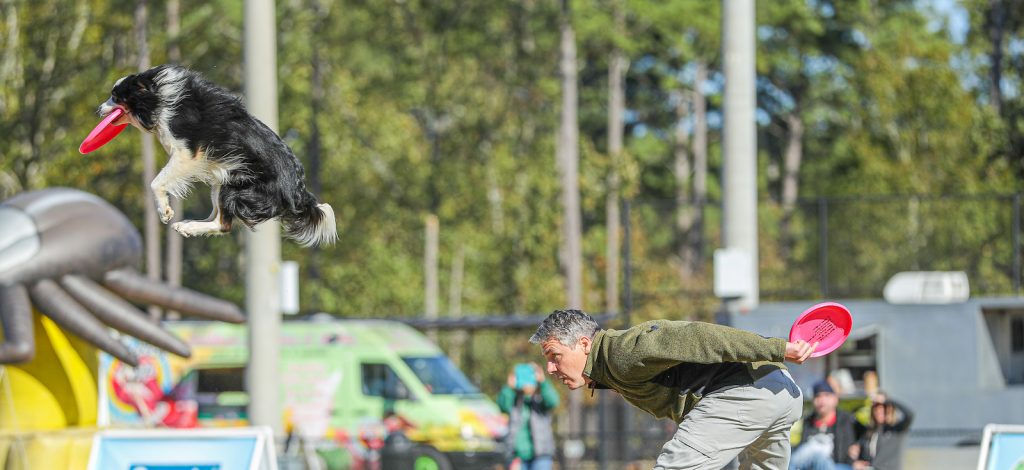
I have poor timing throws on straight backvaults from my back to front. After a through i prepare myself for back vault, i’m with the back to Blue, he’s coming in high speed (i dont like and i’ll never stop him to prepare for vault – here is the connection with flow vs. perfect execution) how do i know *when* to initiate the throw ? Is there any trick to improve my timing, because i know it’s my fault.
Thanks
Bruno
Hi Ron,
I have four videos showing the progression of our vault practice this weekend:
Vault work with Ella 1 – human ball work & bent knee vaults
http://www.youtube.com/watch?v=zHOhc-CGErQ
Vault work with Ella 2 – all human ball as ‘back to drawing board’
http://www.youtube.com/watch?v=UpVuVA9dScA
Vault work with Ella 3 – took it inside teach with cookies.
http://www.youtube.com/watch?v=e5QiJY6I9U8
Vault work with Ella 4 – took vault inside outside; from cookies to frisbee.
http://www.youtube.com/watch?v=A3zzblfSiw4
More detailed commentary for each vid. below.
Vault work with Ella 1
Two phases:
I. human ball vaults
II. bent knee leg vaults
Human ball vaults
1. – once we got good reps on human ball vaults, we moved to knee vaults. We took out all the cueing except marking of the feet touching.
2. – first knee vault almost always worked, but the second and third seemed to always fail. Why?
3. I did notice that after her first vault, on the second, she tried to get her feet on me, but just barely touched one. I didn’t mark it. Is that why her using my thigh for a vault stops completely?
Vault work with Ella 2
1. this is all human ball vaulting work
2. I notice that my timing on the mark is horrible. I mean to mark the feet on the back, but I’m actually marking the take in the air. Does this mean I’m only rewarding for the leap?
Vault work with Ella 3
Since we had trouble getting her to use my thigh as a vault platform, we decided to train using cookies. This was our 3rd session of cookie training her using the thigh as a platform. The 4 sessions where she’s actually using my thigh, were preceded by about 3 sessions of approximations – first sitting in an ‘L’ (legs extended in front of me), adding progressively height and ‘thigh’ until we get to the actual thigh platform utilization for the cookie here.
Vault work with Ella 4
Here we took what we got inside, out doors. There were sessions before where we were giving cookies in the set up position and for thigh contact vaults, with cookie afterwards as reward. We progressed to vaulting for frisbee, using cookies just to get her into vaulting position. We went from Caroline standing in post vault position, to moving out of the picture, and to me using the placer cookie. Even though this method was a little laborious I got a ton of stuff out of this exorcise.
Most notably:
1. using the cookie reinforcer for the best placement for taking the vault helped _me_ to see where the dog needs to be on her approach.
2. looking at this video helps me to see just how bad my marking is. I almost never say ‘yes’ when her feet touch my thigh, the thing I’m trying to increase reps on.
3. The cookie placement after the vault, really helped Ella get her back end around trailing straight behind her as opposed to having it swing out to her left & clockwise, which was happening just on frisbee vaults because of the way I’m presenting the frisbee to her (it moves clockwise, pulling the dog around clockwise – hence her swinging out backend).
I hope these videos show our progression and that you can tell me if where we are now is a good point for progression for 1 more session knee vaults and then try to take it to standing?
Looking forward to your comments!!! Sorry about the number of vids, they are around 2 mins in length 😉
Sue